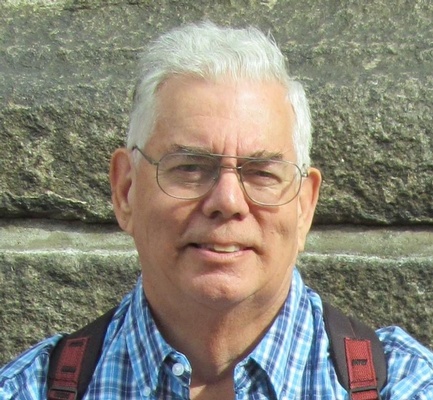

Michel was born in Oklahoma City to G.J. and Coree Lynch in 1939. He attended Millwood, Harding, Classen and graduated from Northwest Classen HS in 1957. In his youth, Michel placed in state and national science fairs. He took flight lessons at Northwest Classen and later became a licensed pilot. He was active in Civil Air Patrol. While helping to install a new pipe organ at St. Paul's Episcopal Cathedral, he developed a life long interest in pipe organs. Michel graduated from the University of Oklahoma with a BS in Physics in 1961 then worked as a research assistant at Texas Instruments. He received an MS in Physics from OU in 1966. His thesis subject was “Acoustical Measurements on Organ Flue Pipes”. He taught at
Oklahoma City University before moving to Gainesville, FL in 1968 to teach at the University of Florida and pursue a doctorate in radio astronomy. Under the direction of Dr Tom Carr, he completed his dissertation “Observation of Jupiter’s Decametric Radiation with a VLB Interferometer”. After completing his PhD in 1972, Michel continued teaching at UF. He consulted on projects pioneering the use of electronics in medical devices. While working at Biomega Corporation, his team developed a blood pressure and pulse monitor. He later taught computer microprocessor design in the ECE department and directed many senior projects until his retirement in 2003. He took special pride in teaching and published the text, “Microprogrammed State Machine Design”. In addition to his enjoyment of woodworking and tropical fish, Michel had a passion for classical music, pipe organs and music synthesis. Always looking to engage in the arts, Mike collaborated with colleagues Ric Rose (dance) and James Paul Sain (music) in the development of the cutting-edge "MIDI Movement Module (M3)". This “dance suit” was used in a number of works, including the techno-ballet “Ender’s Game,” that found performance in the United States, Europe and South America. He assembled a pipe organ in his barn and built a dedicated computer augmented with Hauptwerk ranks to play it. In his retirement, he enjoyed attending concerts and traveling to hear historic pipe organs. Michel is survived by his wife Mary; son, David; daughter-in-law, Julie; and his sisters, Anne and Kathleen. If you wish to honor him, go to a music concert or observe the night sky. I
Donations may be sent to the Friends of the Wanamaker, 630 Hidden Valley Rd., King of Prussia, PA 19406-1712 or to the Organ Historical Society, 330 N Spring Mill Rd, Villanova, PA 19085-1737.
View current weather.
Guestbook
Sign the Guestbook, Light a Candle




Remembering you and keeping you in my heart and prayers. With Much Love, Martha
Mary – Mike was larger than life – with his booming voice, pipe organ, and enormous Santa Gertrudis cattle. He challenged the relationship between dance and music. He will be missed. Many blessings to you and David. I am grateful for the wonderful memories. I hope your memories bring you joy and comfort. Peace be with you.
I can draw a direct line from being Dr. Lynch’s student at UF to where I sit today as an ASIC design engineer working for Apple. I was fortunate enough to have Dr. Lynch as a professor in the last semesters when he taught EEL4712 and EEL4713. He literally wrote the book for the class and designed all the labs. He put a lot of work and passion into his classes and it showed. When I took his classes something "clicked" in my brain and really embraced the way he designed digital systems. I then took the things I learnt from him beyond his class. I used his custom microprocessor architecture in an FPGA for my robotics class and for first job I designed a custom DSP in an FPGA to run multiple PID control loops. For my senior design/research project I cloned a Motorola HC11 processor using the microprogramming and pipelining techniques he taught me. During this time Dr. Lynch was retired but we kept in contact through email and he visited me several times to see my projects. It was these projects that lead me the job I do everyday to support my family. I still have a copy of his book on my desk and have bought copies for others. It was always such a joy to talk to him. He was one of the biggest influences on my life. He will be greatly missed.
I sought out and took one class with Dr Lynch (I was an undergrad and wanted to take his grad level computer architecture course which my friend Jeff Webb TAed. circa 2000) I was not disappointed, I can truly say he had a large impact on my career direction and therefore who I’ve become. I remember in his office once he was demonstrating to me his NEXT computer and interfaces it gave the user, It was a didn’t know what I didn’t know moment, and left me looking for more knowledge on it all. Even though I only had the once class with him, he gave me way more then that in perspective.
Mike and I first met in 7th grade drafting class at Harding Junior High School in Oklahoma City. Mike was always busy doing interesting things and I quickly followed in his footsteps. Soon I was raising tropical fish and attending the junior Gem and Mineral Society along with Mike and his sister Anne. That turned out to be a lifelong hobby of mine. I was already interested in Science when I took my first Science class at Harding, but Mike showed me how Science was also fun in addition to being interesting. His friendship changed my life. Mike and I shared the 9th grade science award at Harding. After Junior High School Mike and I went to Classen High School and were still involved with the Gem and Mineral Society, but otherwise didn’t pal around too much. At the beginning of our junior year Mike went to Northwest Classen High School while I stayed at Classen since it was only 3 blocks from my home. When we were High School juniors Mike and I entered the Oklahoma City Science Fair with a Synthetic Gem Furnace project. Our furnace was theoretically capable of making synthetic Rubies and Sapphires. But when we first tested it, the torch we had built melted and fire and smoke went everywhere. Mike and I decided we should enter separate Science Fair projects when we were seniors. Mike developed a proton linear accelerator out of glass tubing and accelerated the protons using some radio frequency coils. It was quite a neat piece of apparatus. We both won the Oklahoma City Science Fair (tied again) and each of us got to go to the National Science Fair in Los Angeles held at the USC campus. We had a lot of fun on that trip being with a bunch of science fair geeks, some of whom are well known scientists these days. After that fun experience in High School, Mike went to OU to study Physics and I studied engineering physics at O.U. We were both hitting the books and didn’t see much of each other during that time period, but nevertheless stayed close. Mike was one of the groomsmen at my wedding in September of 1963. Later when Mike and Mary were married in Chickasha, Oklahoma, I was a groomsman at their wedding. We only saw each other occasionally after that, but Mike and Mary once hosted a dinner for us while he was teaching at Oklahoma City University. Later in May of 1996, after I had retired from NASA, Paula and I were invited to the STS-77 Space Shuttle launch and while we were there we visited Mike and Mary at their home outside of Gainesville, Florida. Mike had built a large metal barn to house all his pipe organs. It was quite an impressive collection. Mike was a good friend and he will be missed by all that knew him.